


Blog
Pokémon Card Price vs Rarity: Why Rare ≠ Valuable (and the 5,000 PSA 10 Rule)
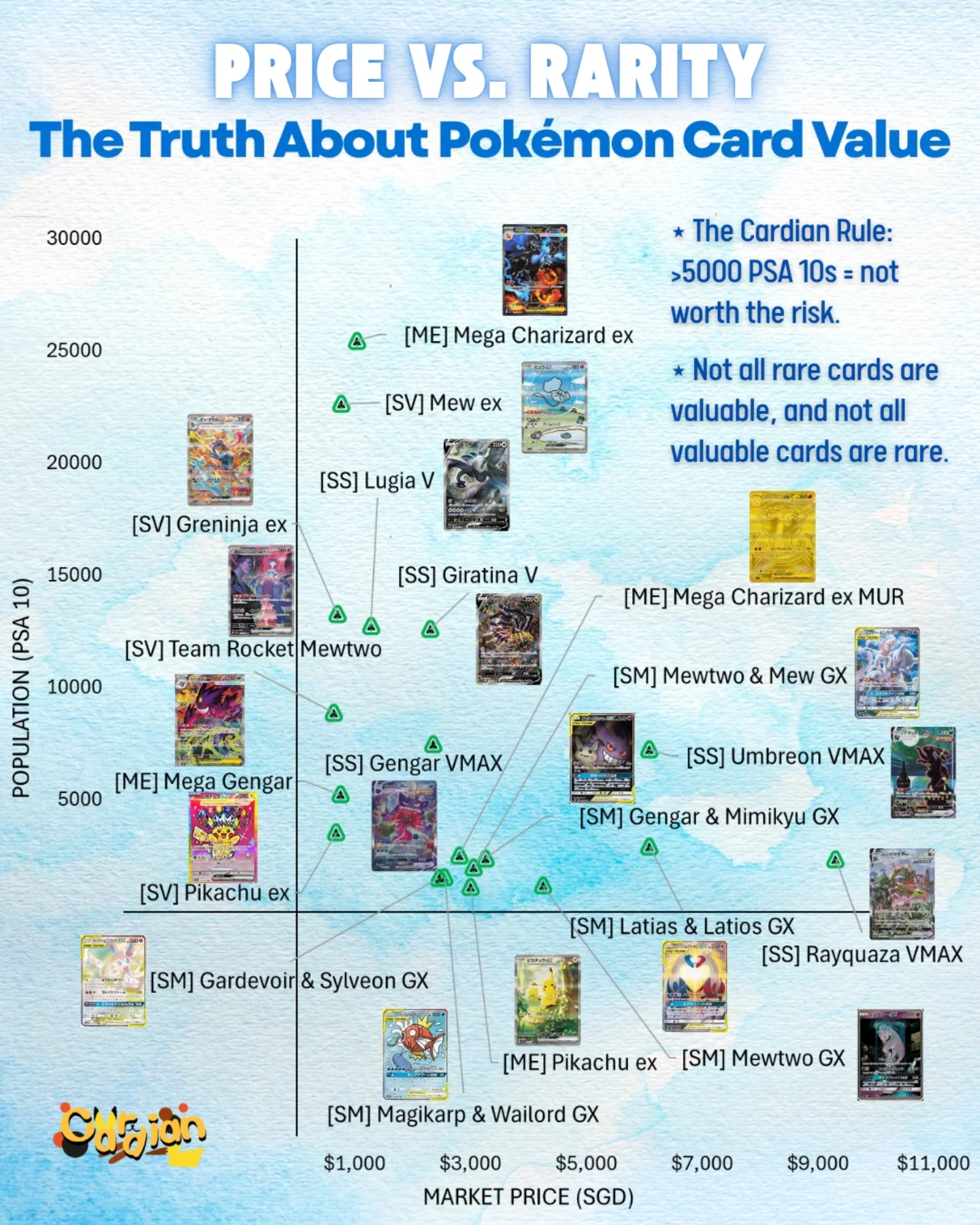
Most collectors assume rarity drives value: the rarer the card, the more it’s worth. The data tells a messier — and far more useful — story. We plotted PSA 10 population against market price for the big chase cards across the Sun & Moon, Sword & Shield, Scarlet & Violet and MEGA eras, and a few clear rules emerged.
PSA 10 populations and SGD prices as charted; figures move over time. Educational only — not financial advice.
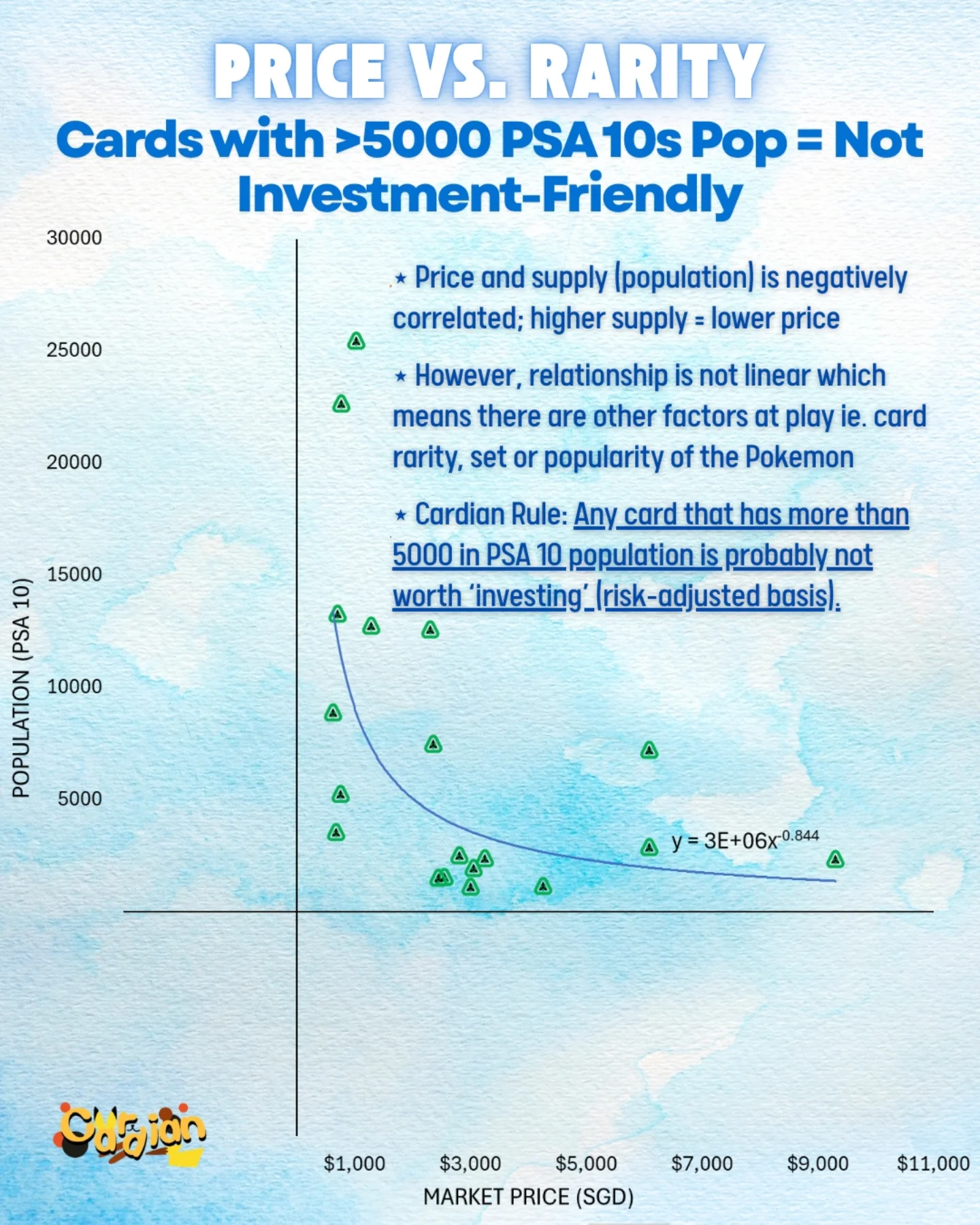
Price and Population: A Negative Correlation, but Not a Straight Line
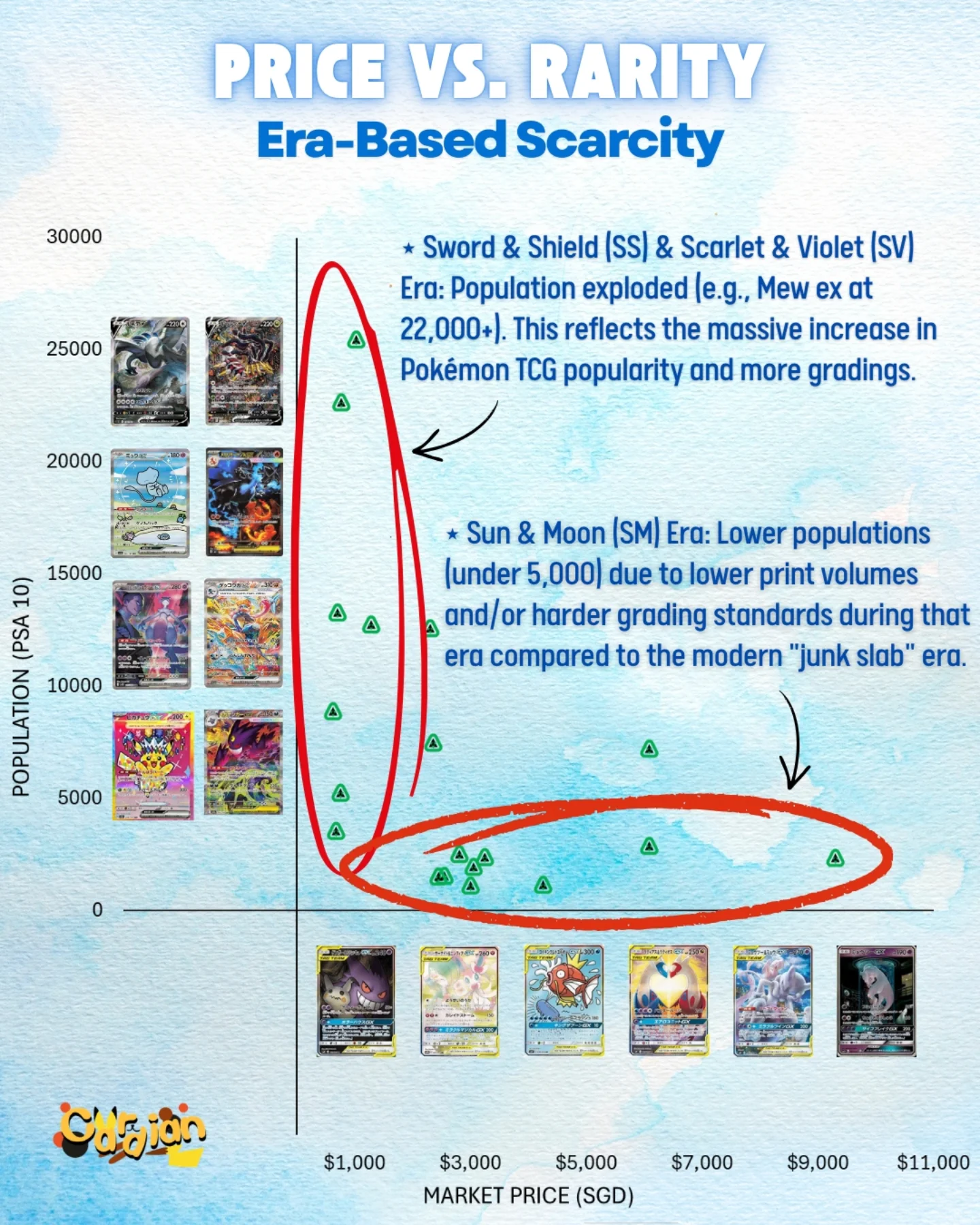
Across the board, price and supply (PSA 10 population) are negatively correlated: higher supply means lower price. The best-fit relationship is a power curve, not a straight line — which tells you other factors are always at play: the card’s rarity tier, its set, and above all the popularity of the Pokémon on it.
The Cardian Rule: Over 5,000 PSA 10s = Think Twice
Our simple screen for any modern chase card: if a card has more than 5,000 copies in PSA 10, it’s usually high-risk — or low-upside — as an “investment”, on a risk-adjusted basis.
The two corollaries matter just as much: rare doesn’t automatically mean valuable, and valuable doesn’t always mean rare. Population data is public — checking it before you buy is the single cheapest piece of homework in the hobby.
Why Iconic Cards Can Stay Cheap
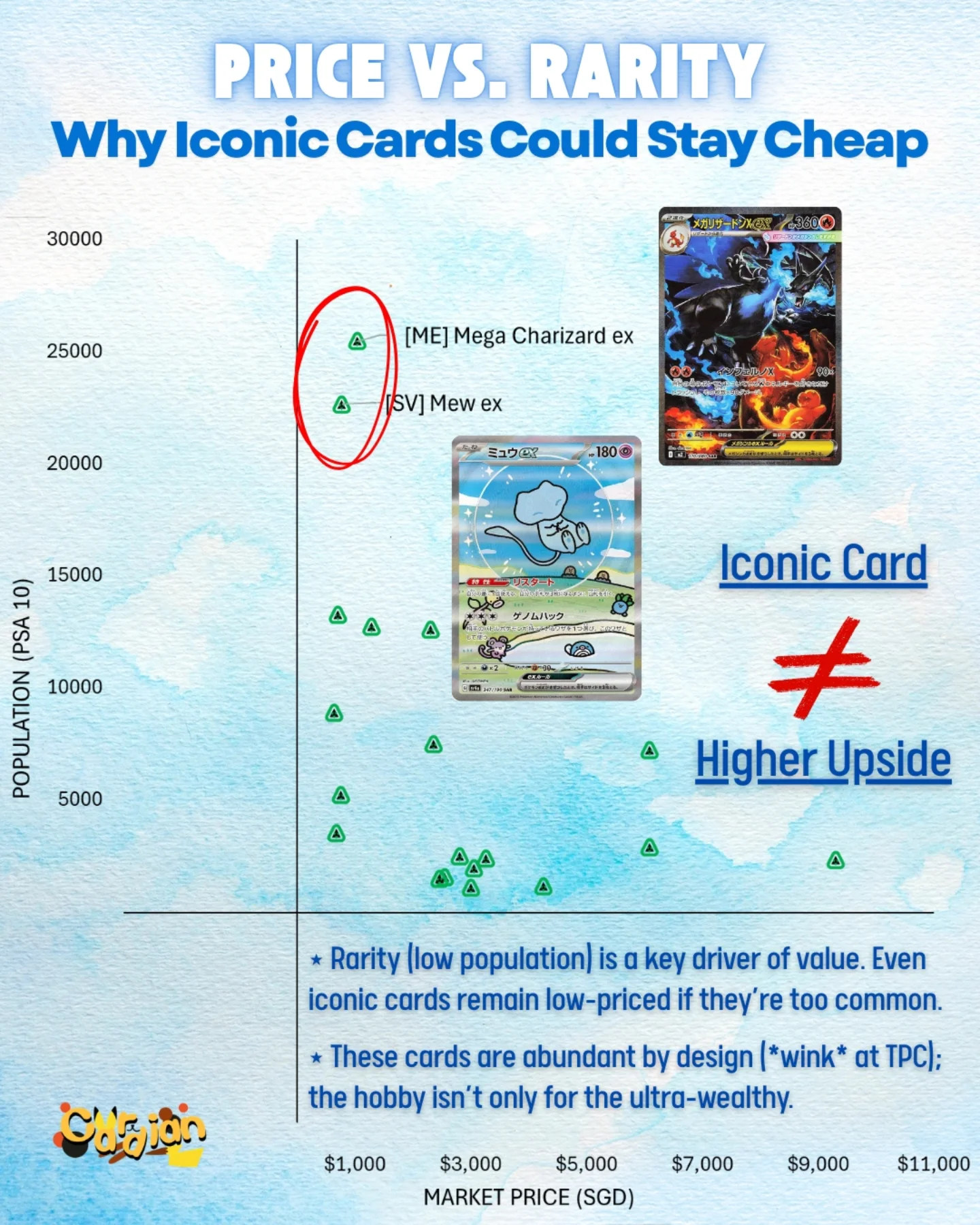
Mega Charizard ex sits at roughly 25,000+ PSA 10s. Mew ex from Scarlet & Violet is above 22,000. These are some of the most beloved cards in the modern game — and they remain affordable precisely because they’re everywhere.
That’s not an accident. The Pokémon Company prints fan favourites in volume by design: the hobby isn’t meant to be only for the ultra-wealthy. It’s great news for collectors — and a warning for anyone buying an iconic card expecting it to appreciate. Iconic ≠ higher upside.
The Grail Outliers
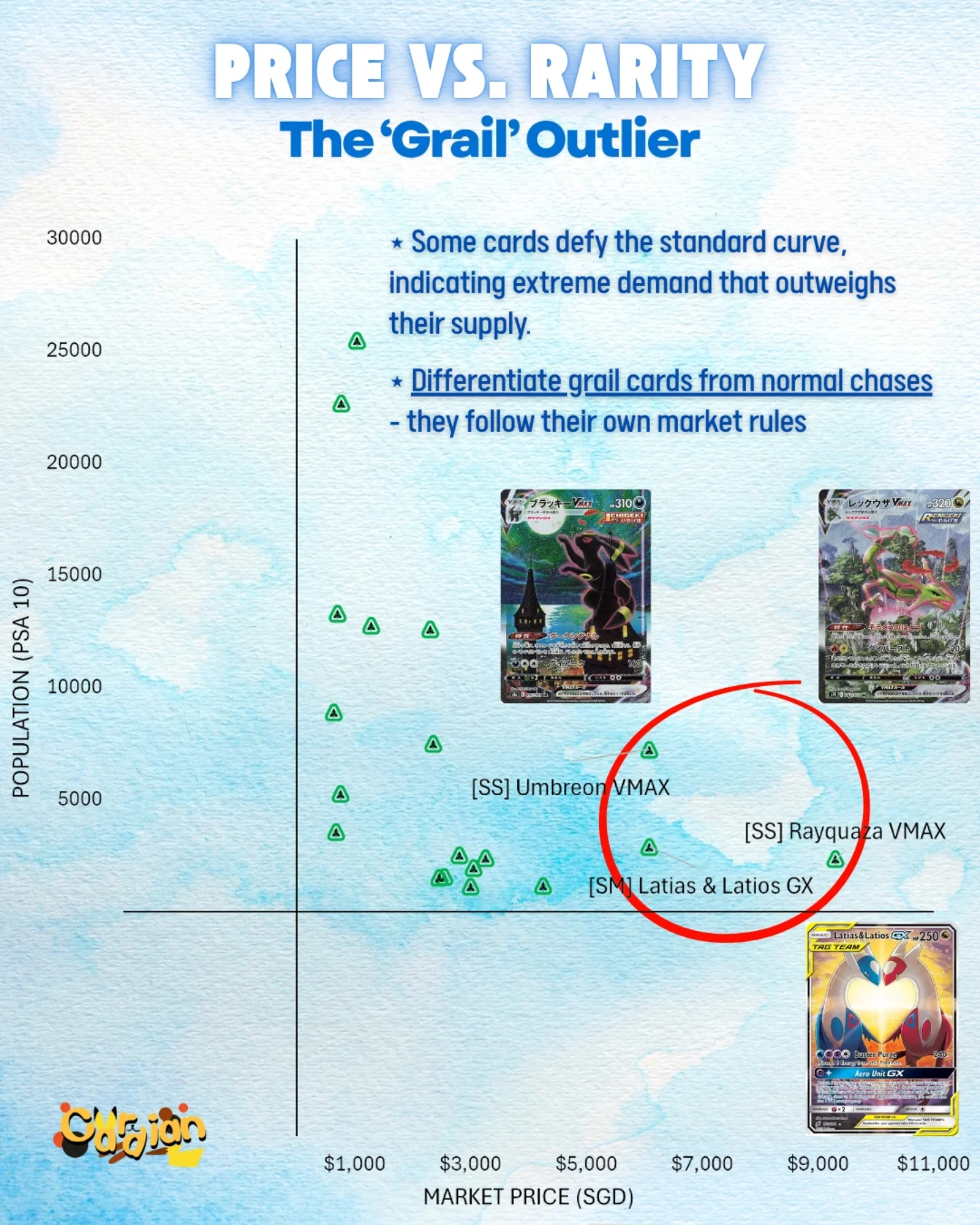
Some cards defy the curve entirely. Sword & Shield Umbreon VMAX (“Moonbreon”), Rayquaza VMAX and Sun & Moon Latias & Latios GX all trade far above what their populations alone would predict. That’s extreme demand outweighing supply — and it’s why grail cards need to be judged separately from normal chase cards. They follow their own market rules.
Era Matters: Scarcity Is Relative
Population size depends heavily on when a card was printed:
- Sword & Shield and Scarlet & Violet era — populations exploded (Mew ex at 22,000+), reflecting the huge surge in Pokémon TCG popularity and far more cards being sent for grading.
- Sun & Moon era and earlier — populations often sit under 5,000, thanks to lower print volumes and what many collectors consider stricter grading standards compared with the modern “junk slab” era.
So a “low pop” modern card and a “low pop” 2018 card are not the same thing — always read population in the context of its era.
What This Means for Your Collection
Popularity and low population together drive long-term value — one without the other usually disappoints. The goal isn’t just owning cards that win in a bull market; it’s owning cards that won’t lose in a bear market. Before any significant purchase: check the PSA population, ask why the card is scarce (or isn’t), and ask whether the Pokémon on it is genuinely loved.
If you want the deeper dives, read our guides on Chinese-exclusive Pokémon cards — where population data is central to the story — and our June 2026 Japanese market update, where the same rotation from hype to scarcity played out in real time.
FAQ
Are rare Pokémon cards always valuable?
No. Rarity only translates into value when the card is also genuinely popular. Plenty of scarce cards stay cheap because demand isn’t there — and some common cards command strong prices purely on demand.
What is a “good” PSA 10 population for an investment-grade card?
As a rule of thumb, we treat anything above 5,000 PSA 10s as high-risk or low-upside. The strongest performers tend to combine low population with high, durable demand.
Why do older Sun & Moon cards have lower populations?
Lower print runs, fewer collectors grading cards at the time, and arguably stricter grading standards. Modern sets are printed and graded at many times the volume.
What is a grail card?
A card whose demand is so extreme it breaks the normal price-vs-population relationship — think Moonbreon (Umbreon VMAX Alt Art). Grails follow their own market logic and shouldn’t be compared directly with regular chase cards.
Trainer Club perk: use code TRAINERCLUB at checkout on cardian.sg. Browse our Pokémon singles and PSA & CGC graded slabs — every card population-checked by people who care about this stuff way too much.