

Blog
Forestchu: The Pikachu Almost Nobody Can Pull — and Why It Dropped 46%
Some cards are rare because of print runs. “Forestchu” is rare because of a lottery — and because the lottery gets rigged before you ever get a ticket. Here’s the full story of Pikachu ex 764/742, the chase card from Start Deck 100 Battle Collection that peaked at S$5,200, dropped 46%, and might now be trading below what it actually costs to pull one.
Prices in SGD, July 2026, PSA 10 unless stated. Educational only — not financial advice.
What Is “Forestchu”?
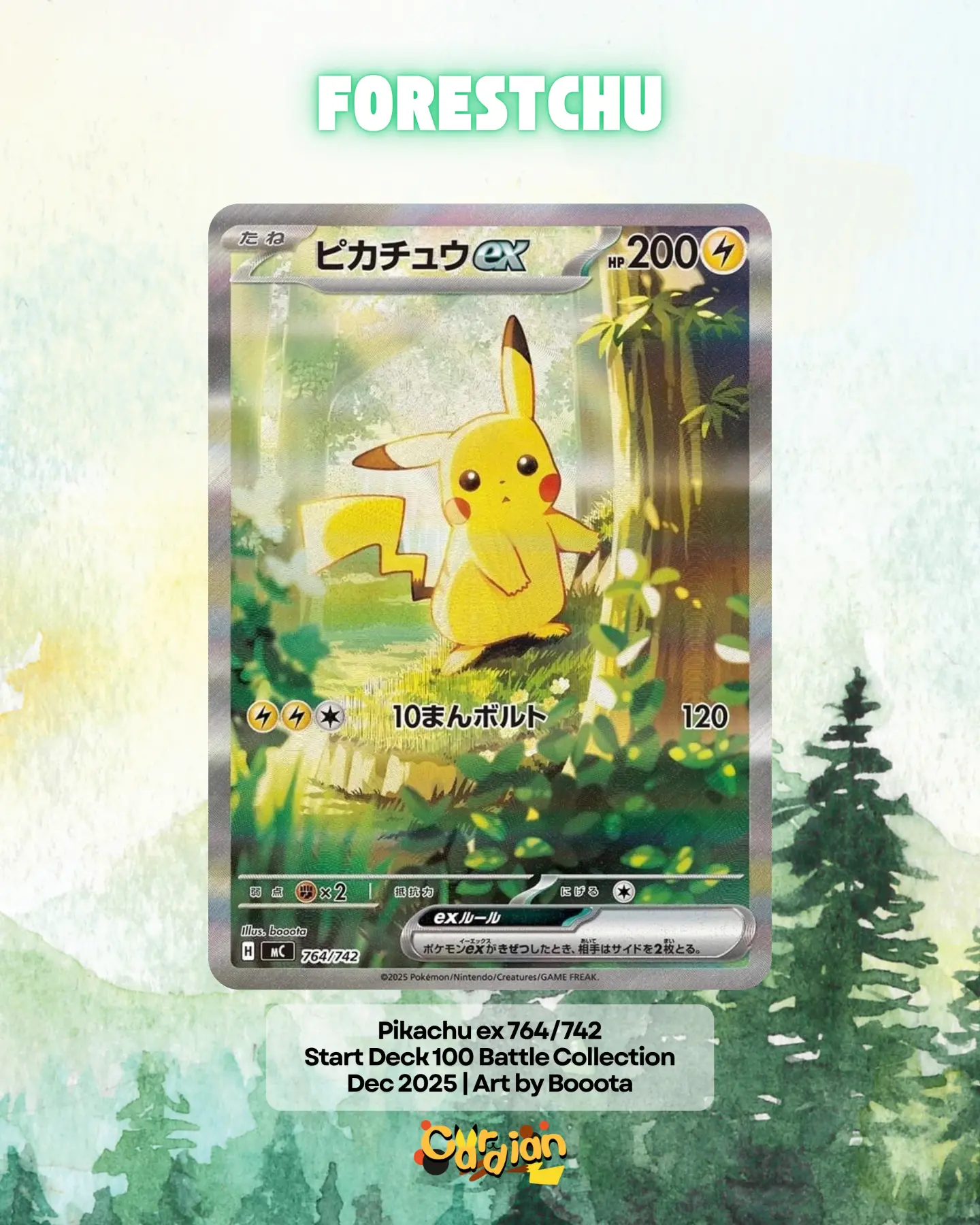
Pikachu ex 764/742 comes from the Japanese Start Deck 100 Battle Collection (December 2025). Illustrated by Booota, it shows Pikachu in a watercolour forest — hence the community nickname. It’s a Special Art Rare that exists in exactly one of the product’s 100 pre-built blind decks.
Why It’s So Hard to Pull: The Box-Weighing Problem
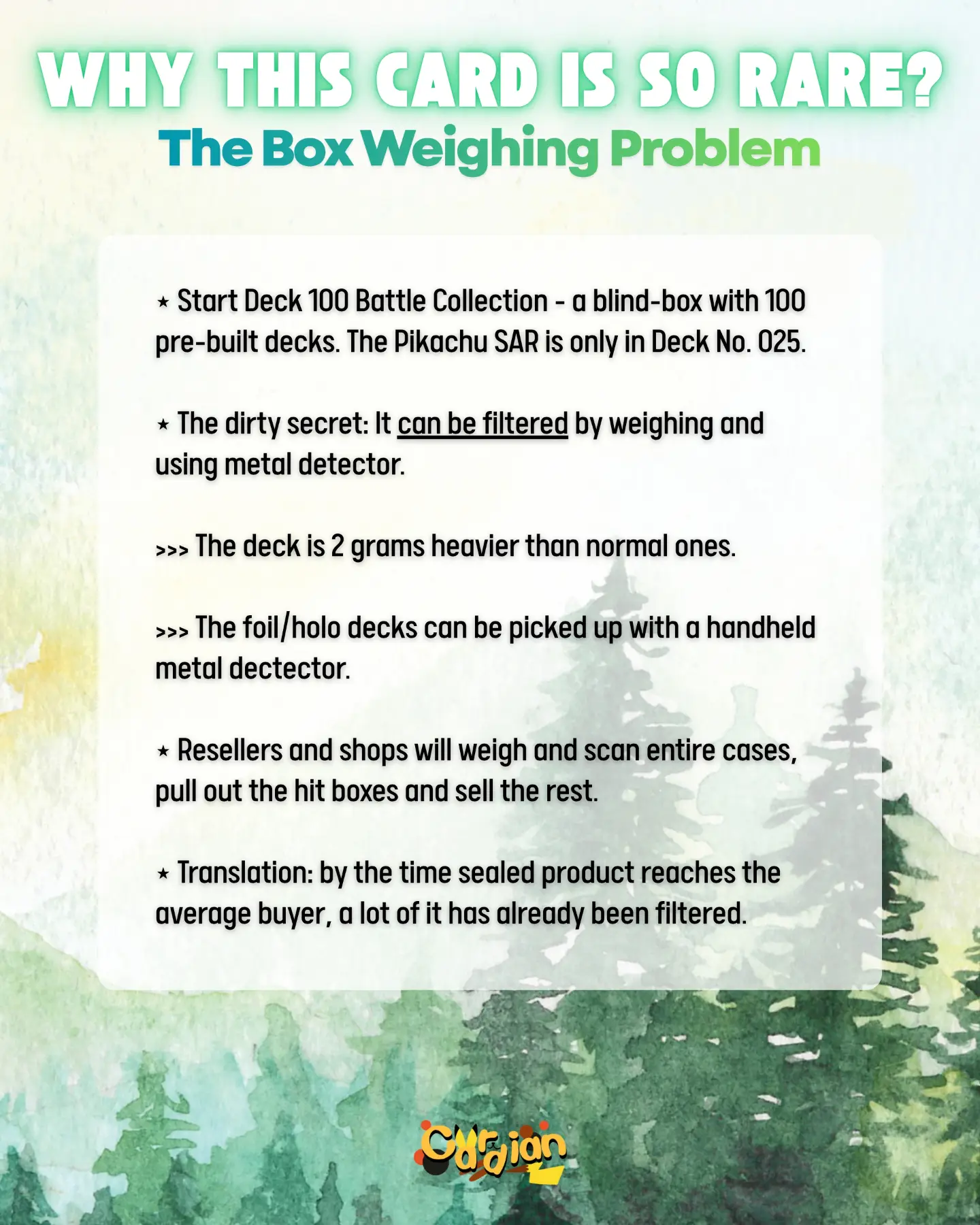
Start Deck 100 is a blind-box product — 100 numbered decks, and the Pikachu SAR lives only in Deck No. 025. The dirty secret: hit decks can be identified without opening anything. The SAR decks run about 2 grams heavier than normal ones, and the foil cards inside can be picked up with a handheld metal detector. Resellers and shops weigh and scan entire cases, extract the hit boxes, and sell the rest — so by the time sealed product reaches an average buyer, much of it has already been filtered.
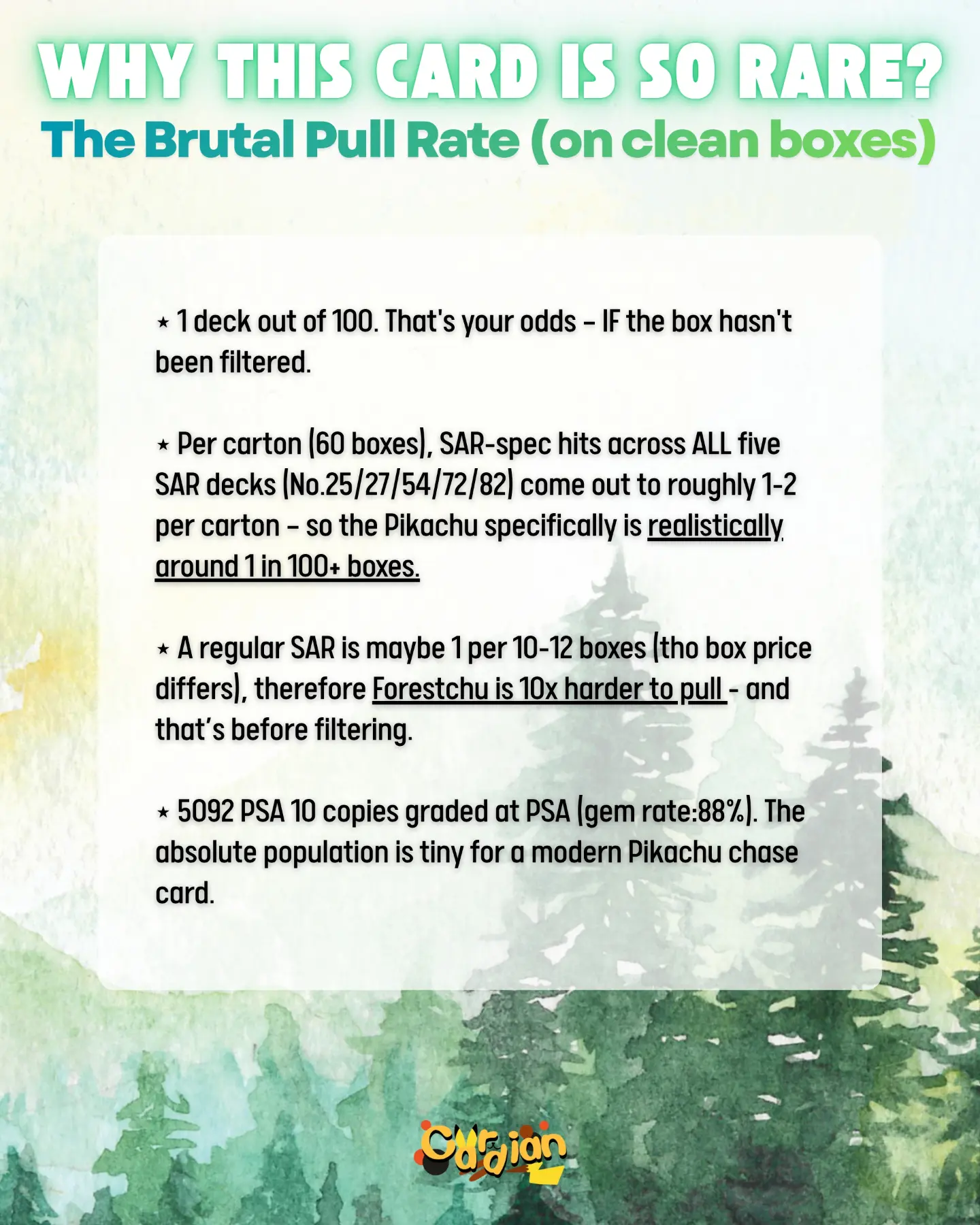
The Real Pull Rate
On clean, unfiltered boxes the odds are 1 in 100. Per 60-box carton, SAR-spec hits across all five SAR decks (No. 25, 27, 54, 72 and 82) come to roughly one or two — which puts the Pikachu specifically at around 1 in 100+ boxes. A regular modern SAR is maybe 1 per 10–12 boxes, so Forestchu is roughly ten times harder to pull — before accounting for filtering. The graded population reflects it: about 5,092 PSA 10 copies (an 88% gem rate), tiny for a modern Pikachu chase card.
The Price Story: Dump, Climb, Peak, Correction
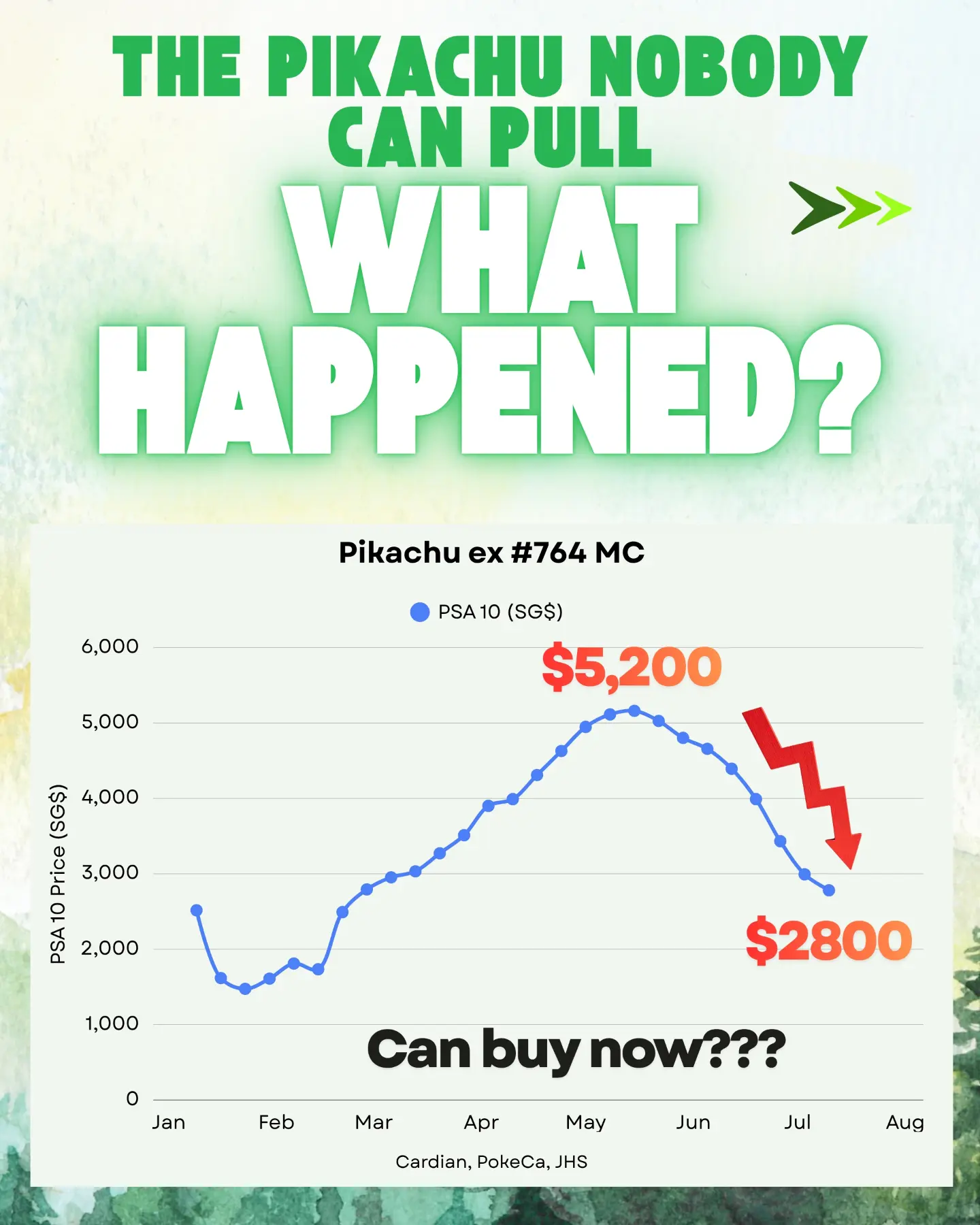
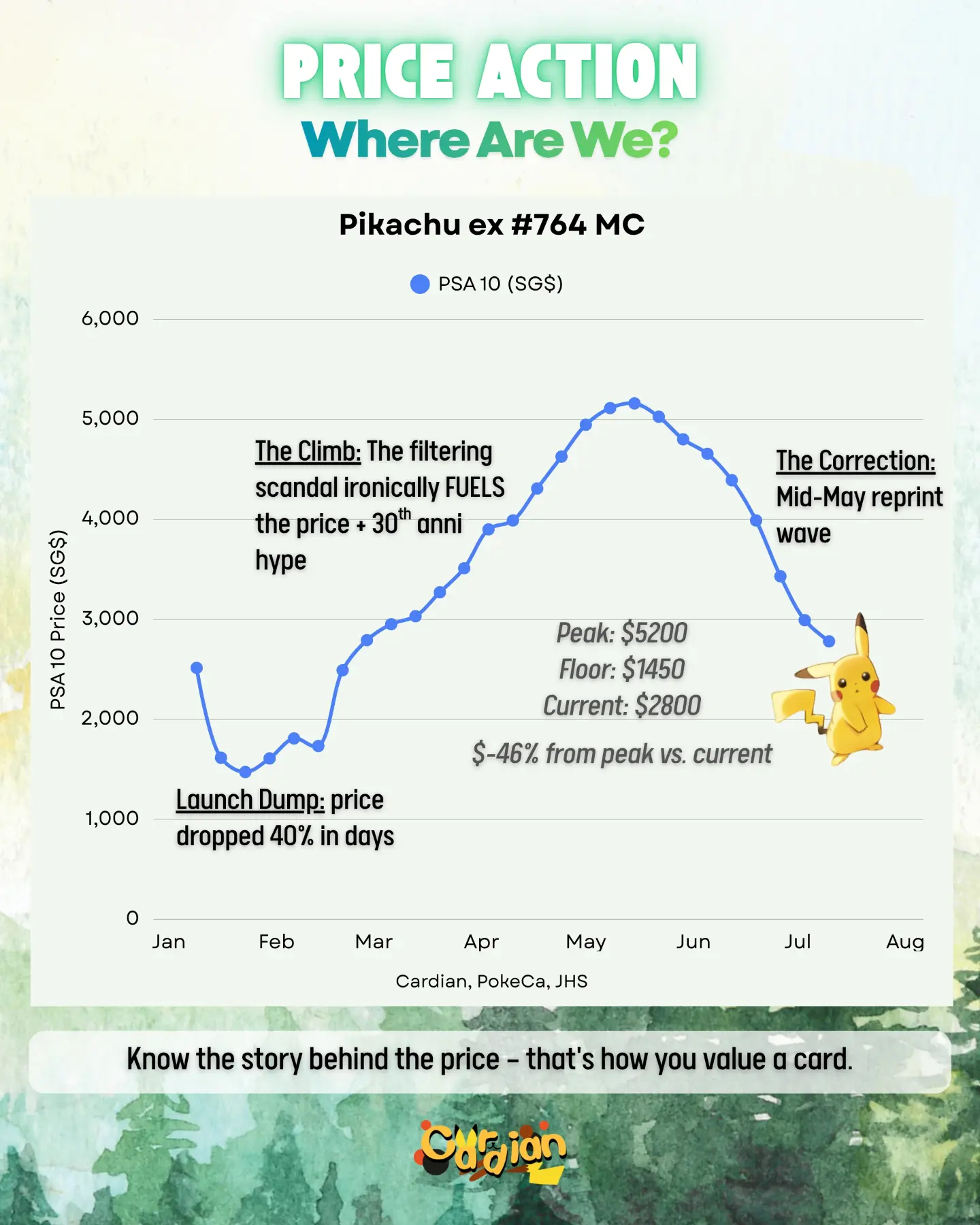
The chart tells a complete market cycle in seven months:
- Launch dump — the price dropped ~40% within days of release, the usual supply flood.
- The climb — ironically, the box-filtering scandal fuelled the price: it convinced the market the card was near-impossible to pull. Add 30th-anniversary hype, and the card ran to a S$5,200 peak in May.
- The correction — a mid-May reprint wave of Start Deck 100 knocked it back down to roughly S$2,800, about −46% from the peak (the floor earlier in the cycle was S$1,450).
Bull Case vs Bear Case
The bull case: it’s still a 1-in-100 deck lottery, reprints add relatively few real copies to the market, holders are locked in ahead of Pokémon’s 30th anniversary — and crucially, the price corrected rather than collapsed.
The bear case: collectors have seen this movie. McDonald’s Pikachu peaked around S$500 on the same “it’s Pikachu, it’s rare” logic — then Japan’s real supply surfaced and it never recovered. Supply beats hype, every time. If Japan keeps reprinting Start Deck 100 relentlessly, “rare” gets diluted one wave at a time.
The Valuation Math
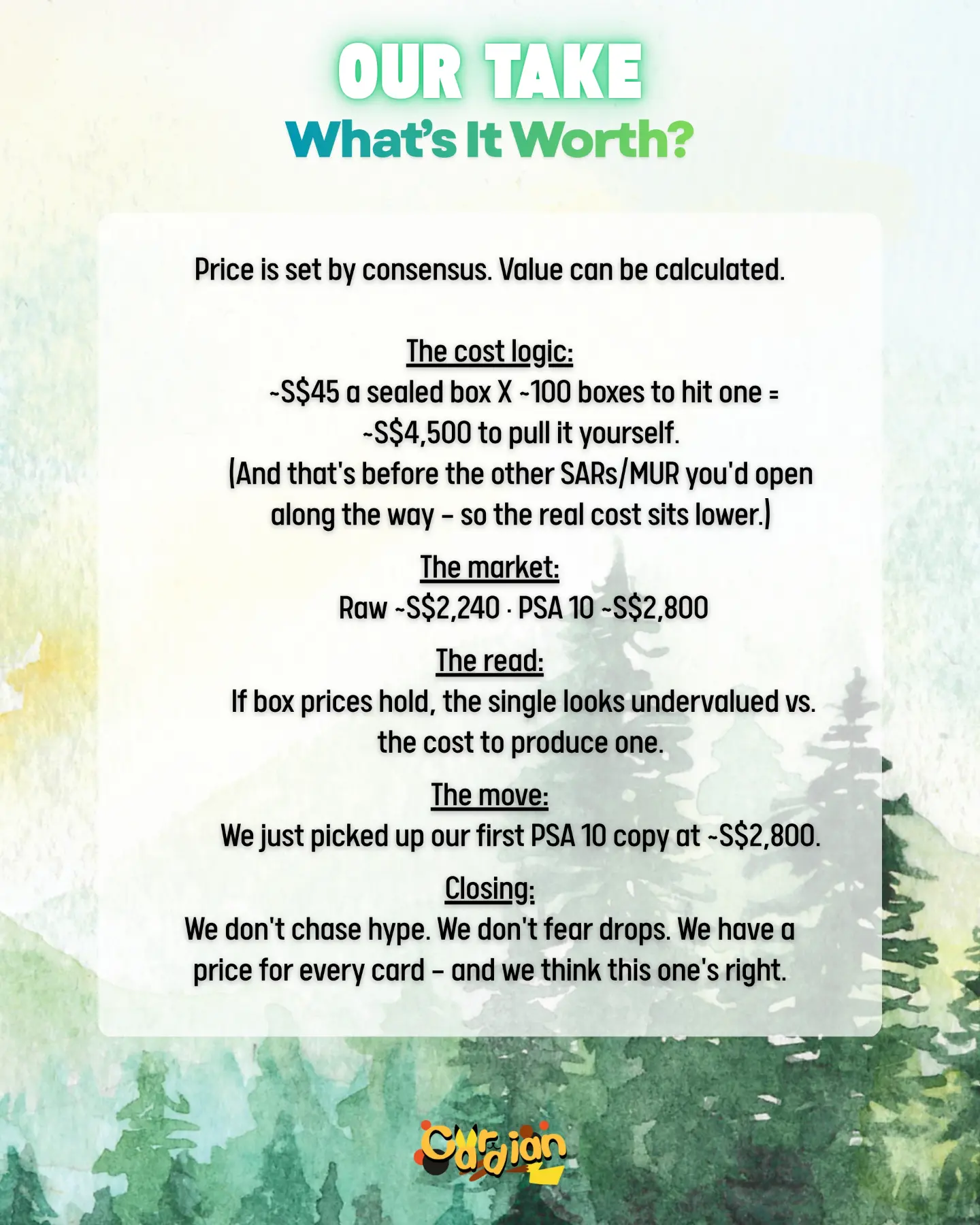
Here’s the way we think about it: price is set by consensus, but value can be calculated. A sealed box runs about S$45, and on clean boxes you need ~100 of them to expect one Forestchu — roughly S$4,500 to pull one yourself (and that’s before crediting the other SARs you’d open along the way, which lowers the real cost somewhat). Against that, the market currently asks about S$2,240 raw and S$2,800 for a PSA 10.
If box prices hold, the single looks undervalued relative to what it costs to produce one. That’s why we bought our first PSA 10 copy at around S$2,800 — not chasing the hype on the way up, not fearing the drop on the way down. We have a price for every card, and we think this one’s about right.
The Bigger Lesson
Supply and demand beat character popularity — the same conclusion as our price-vs-rarity deep dive. Whether this is the floor before the anniversary, or the next McDonald’s Pikachu, comes down to one thing: whether the reprints keep coming.
FAQ
What is Forestchu?
The community nickname for Pikachu ex 764/742, a Special Art Rare from the Japanese Start Deck 100 Battle Collection (December 2025), illustrated by Booota.
Why is Pikachu ex 764/742 so rare?
It appears in only 1 of the product’s 100 blind decks (Deck No. 025), and hit decks are routinely filtered out of circulation by weighing and metal detection before reaching retail buyers — making real-world odds worse than 1 in 100 boxes.
Why did Forestchu’s price drop?
A mid-May 2026 reprint wave of Start Deck 100 corrected the price from its S$5,200 peak to around S$2,800 — a 46% drawdown, though still well above its S$1,450 early floor.
Is Forestchu worth buying now?
Pulling one yourself costs roughly S$4,500 in sealed boxes at current prices, versus ~S$2,800 for a PSA 10 single. If box prices hold, the single trades below production cost — our view, not financial advice. Card prices can fall as well as rise.
Looking for graded Pikachu chase cards or Japanese singles? Browse our PSA & CGC slabs and Japanese Pokémon singles — or follow @cardian.sg where we break down one card’s story at a time.